You and Whose Economy?: Group-Based Retrospection in Economic Voting
Christoffer H. Dausgaard
American Journal of Political Science (forthcoming)
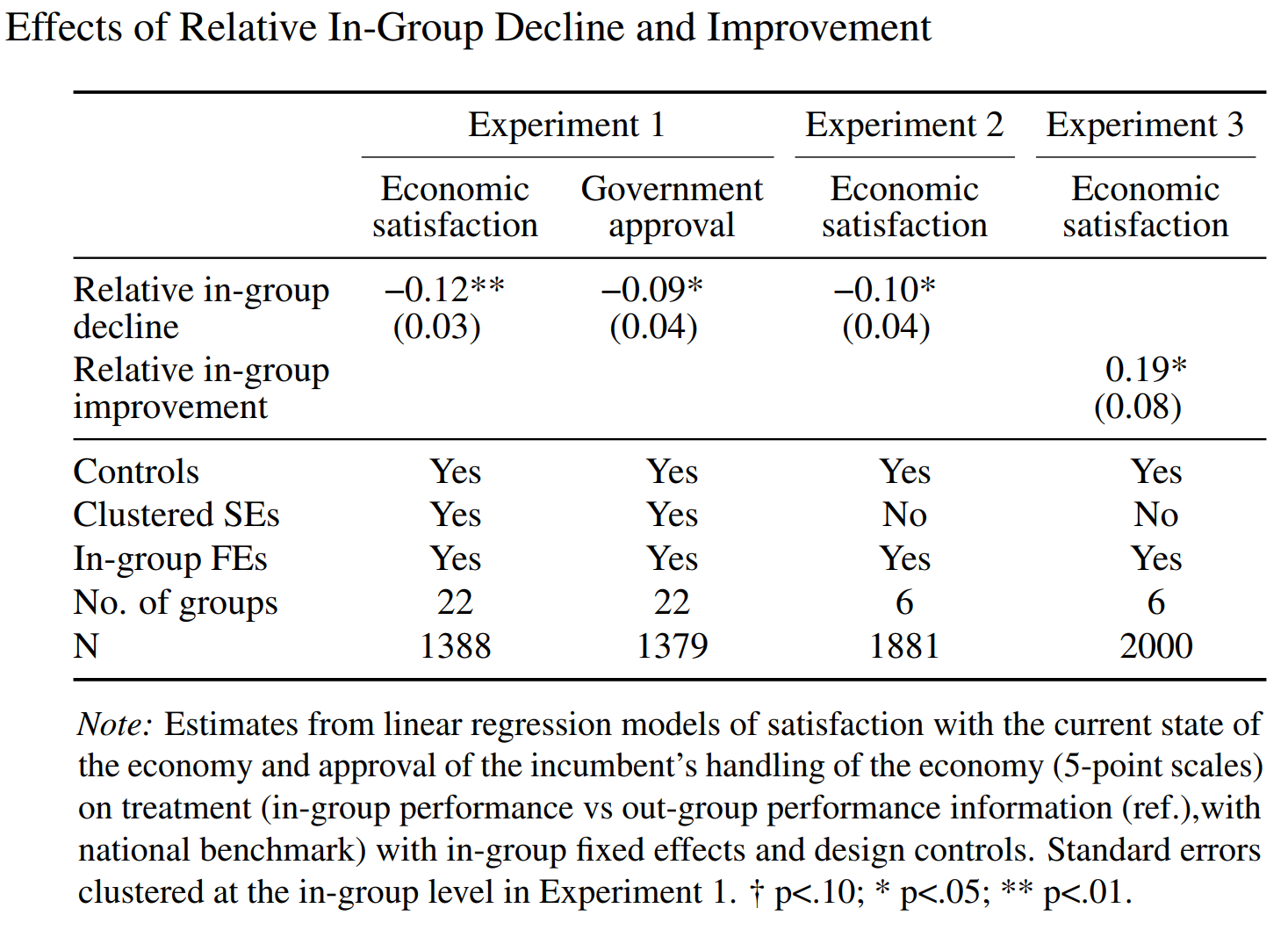
When managing the economy, governments make decisions that influence not only overall growth but also its distribution. How do voters judge incumbents for this? I revisit the idea of group-based retrospective voting and argue that voters assess the economic performance of their social in-groups relative to the national economy. By sanctioning the incumbent for in-group performance, voters can incentivize policy-making that better aligns with their interests. I test the theory, first, by estimating the relationship between in-group performance and incumbent support in panel data. This relationship is comparable in magnitude to sociotropic voting. I further conduct three experiments in Denmark and the United States, randomizing information about the performance of groups defined by geography, age, education, ethnicity and class. The findings suggest there are limits to sociotropic voting, as voters want their groups to follow or beat the national trend. This has important implications for electoral accountability and party competition.
Group Sympathy and Party Choice: A Longitudinal and Comparative Analysis of Reference Group Theory
Rune Stubager, Christoffer H. Dausgaard, Lena Maria Huber, Michael Lewis-Beck
European Journal of Political Research (forthcoming)
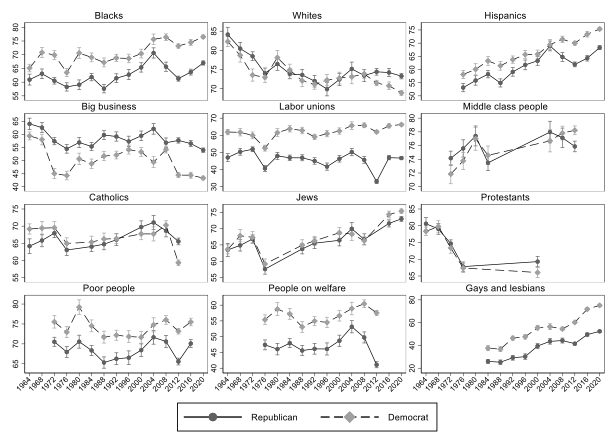
Recent scholarship devotes considerable attention to how social identities influence vote choice. However, group sympathies or group affect constitutes another, often overlooked subjective component of the relationship between social groups and vote choice. Based on reference group theory and drawing on ANES data as well as recent Danish and Austrian election surveys, we examine how voters’ sympathies with a range of groups are related to party choice across time and space. We find that group sympathies are related to vote choice in all three countries even when controlling for objective group memberships and social identities. Across time, most relationships are stable or strengthening and comparable in strength to the relationship between group memberships and party choice. The relationship between group sympathies and vote choice is, furthermore, conditioned by perceived linkages between groups and parties. Hence, analyses of the role of social groups in voting need to also include group sympathies to grasp the full influence of social groups.
Elite Rhetoric and the Running Tally of Group Linkages
Christoffer H. Dausgaard, Frederik Hjorth
Journal of Politics (forthcoming)
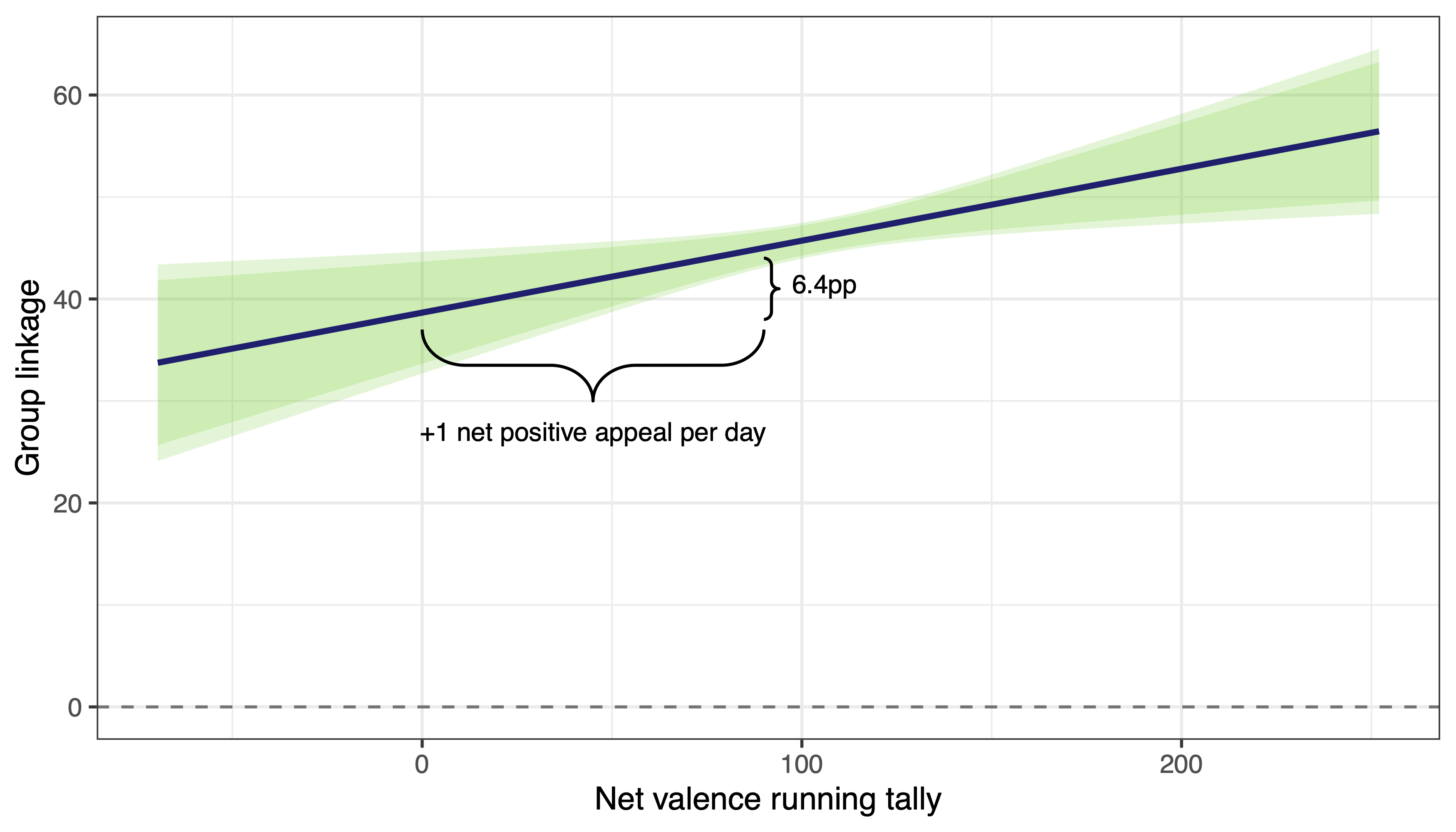
Parties’ linkages to social groups are key to electoral competition. While traditionally explained in terms of long-standing social cleavages, newer theories assign some role to parties in shaping group linkages. We argue that party elites have even more influence over group linkages than afforded in existing accounts: citizens infer group linkages from `running tallies’ of recent group appeals in elite rhetoric. To test this theory, we develop a novel automated approach that uses language models to measure group appeals observationally. Using data from the UK, we connect citizens’ perceived group linkages in surveys to group appeals in parliamentary speech spanning three decades. We find that group linkages robustly track party elites’ rhetoric. The association is strongest for group appeals with policy content and among recent news media consumers. Our findings imply that party elites have considerable power to shape group linkages, even in the short run.
Accommodating the Radical Right: Cross-Country Experimental Evidence
Christoffer H. Dausgaard, Frederik Hjorth, Martin Vinæs Larsen
Revise and Resubmit, American Political Science Review
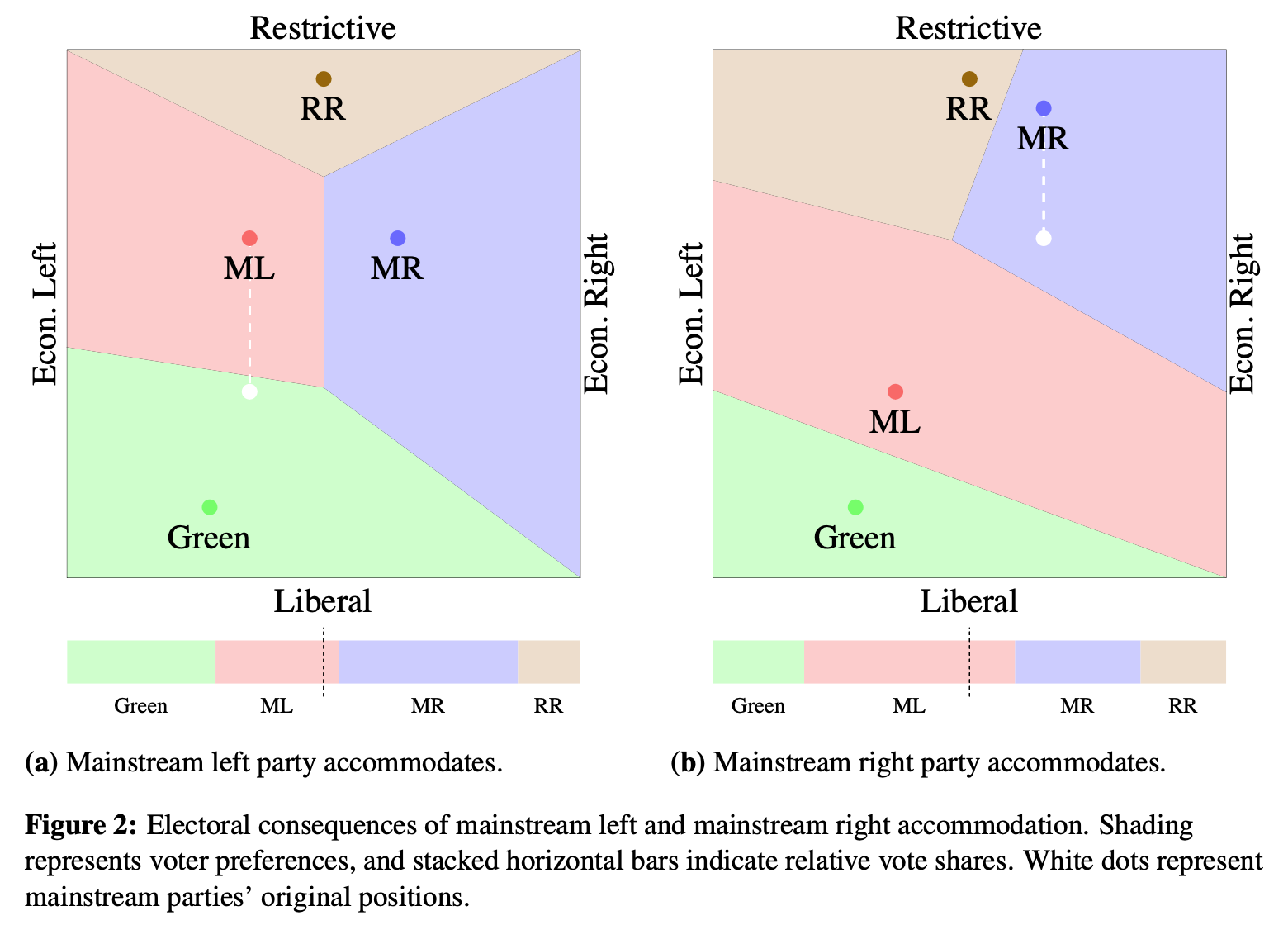
In European politics and beyond, parties of the mainstream left and right must grapple with how to respond to the rise and consolidation of radical right parties (RRPs). A prominent debate in political science centers on the efficacy of `accommodative’ strategies for mainstream parties. However, existing evidence is weakened by endogeneity concerns and limited external validity. We contribute to this debate with a well-powered cross-country experimental design in four prominent cases (Denmark, Sweden, Spain, and Germany). Our design not only strengthens internal and external validity but also incorporates both mainstream left and right parties within a unified theoretical framework, and measures outcomes beyond vote choice, including the perceived legitimacy of RRPs. In doing so, we provide novel, comprehensive evidence of the trade-offs mainstream parties face when adopting accommodative strategies in multiparty systems.
Who (Else) Benefits?: Group-Based Responses to Distributive Policies
Christoffer H. Dausgaard
Working paper
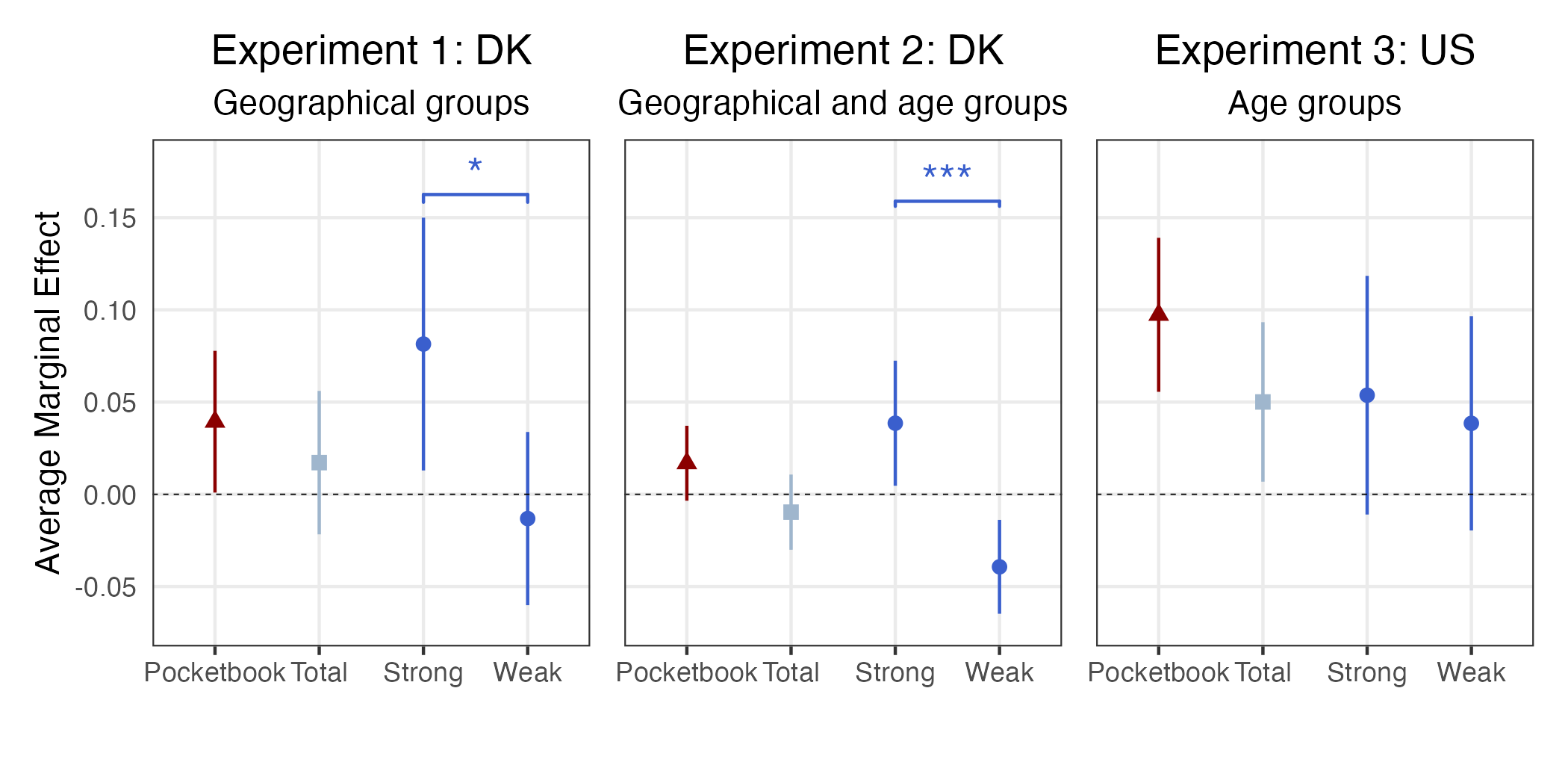
A central question in public opinion is how voters respond to distributive policies that benefit them. The common expectation is that voters reward incumbents for personal benefit, following a pocketbook voting logic. Yet, the pocketbook explanation has received little direct empirical scrutiny. In this paper, I challenge the pocketbook account and argue that existing studies conflate personal benefits with perceived benefits to voters’ in-groups. I theorize a group-based mechanism in which voters respond to distributive policies based on how they believe those policies affect certain salient in-groups. I test the argument in two empirical studies. First, using survey data on COVID-era stimulus checks in Denmark and the United States, I show that check recipients became more likely to believe their racial or geographical in-groups also benefited. These findings reveal that distributive perceptions are endogenous to personal benefit, casting doubt on the common attribution of policy effects to pocketbook voting. Second, to isolate the causal role of group-based perceptions, I field three pre-registered experiments in the two countries, randomly varying features of hypothetical cash transfer policies. Across experiments, I find that voters’ political support depends at least as much on perceived in-group benefit as on personal gain. Importantly, these effects are highly group-dependent, emerging only for groups with strong political identities. Together, the findings show that group-based responses, not just pocketbook concerns, shape how voters react to policies that benefit them, helping explain the wide variation in policy effects across contexts.
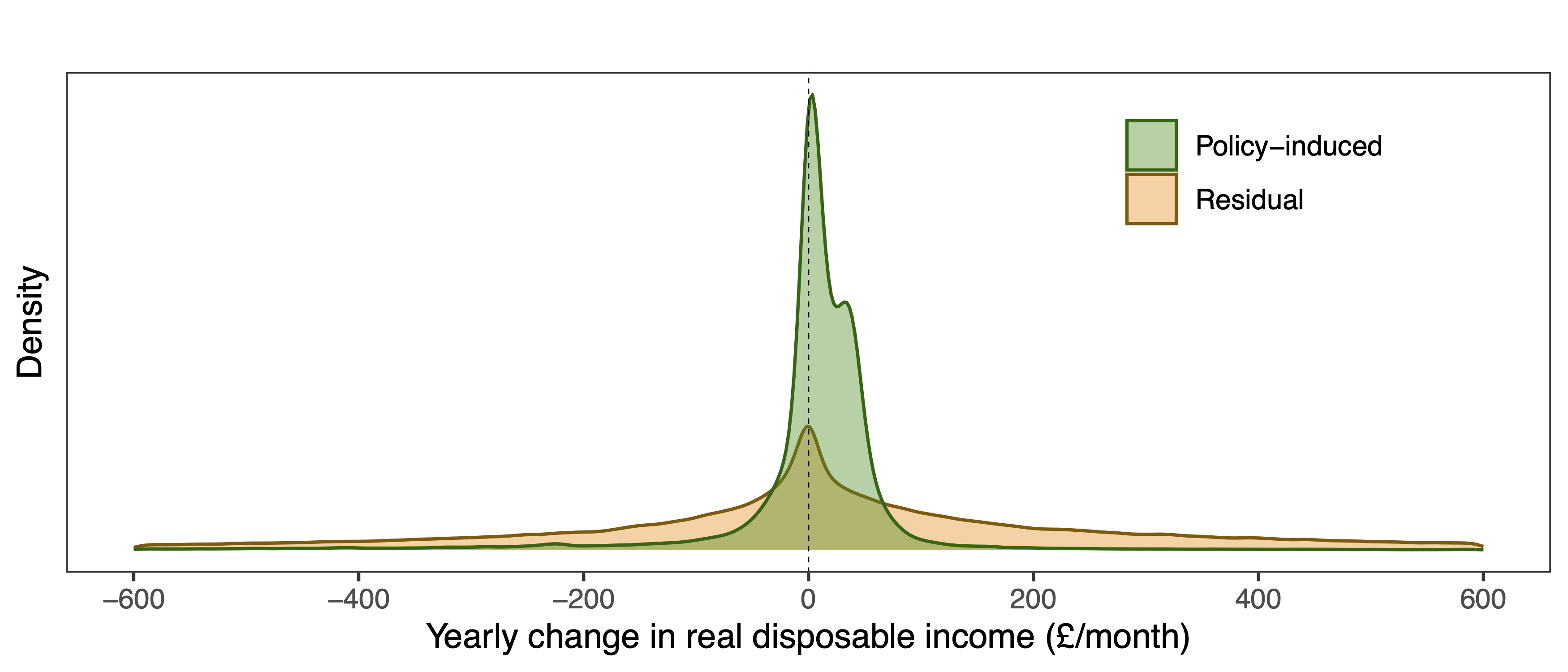
People often vote with their pocketbooks. Is this an effective tool for holding governments accountable? A key unresolved question is whether voters reliably respond to the policy-induced component of their income changes or simply react to all income changes regardless of cause. Existing research cannot definitively answer this question due to methodological limitations: studies of single policies cannot distinguish voters responding to the income shock itself or to income changes regardless of their origin, while research on pocketbook attribution relies on potentially biased self-reports. To answer the question, I introduce a novel approach linking a large survey panel to policy microsimulation models that track how tax-and-transfer policies directly affect disposable incomes. This allows me to decompose respondents’ total disposable income changes into policy-induced and residual components, providing a direct test of what income variation drives pocketbook voting. Applying this approach to the UK in the 2010s, a case of significant policy-driven income variation, I find that voters do not hold incumbents more accountable for policy-induced than residual income changes on average. Instead, they respond to total income changes, which prove to be a poor proxy for policy-induced income changes. These findings suggest that voters fail to reliably reward and punish incumbents for policies that affect their disposable incomes. Pocketbook voting may therefore be a weaker accountability mechanism than commonly assumed.
Elected Losers. How Party Performance Affects Legislators' Satisfaction with Democracy. Evidence from Latin America
Daniel Cruz, Christoffer H. Dausgaard
Under review
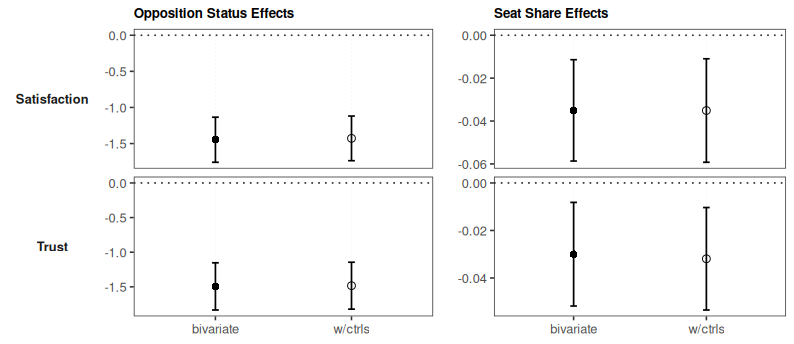
Does party performance in elections shape elected politicians’ satisfaction with democracy? While losing candidates are known to become less satisfied with democracy, little is understood about how winning politicians react when their party underperforms. This article argues that elected officials grow frustrated with democracy when their party loses influence over the executive or legislative branch. Using longitudinal data from 8,141 Latin American legislators, we show that both opposition status and seat losses reduce democratic satisfaction and trust in elections. These effects are robust across specifications and remain significant even in consolidated democracies. Running the models among individuals identified using observables ($N=$ 1,535) render similar results. Interviews with opposition legislators suggest that dissatisfaction is often channeled through frustrations with internal party dynamics. Our findings have critical implications for democratic stability, as discontented legislators hold formal decision-making power. Moreover, these elected losers may amplify broader dissatisfaction due to their visibility as winning candidates.
Book Chapters
Voters' sympathies with social groups. An overlooked factor behind party choice
Christoffer H. Dausgaard, Rune Stubager
Partiledernes Kamp Om Midten: Folketingsvalget 2022
In this chapter, we examine voters’ sympathies with seven key groups - the young and the elderly; the working class and the upper middle class; urban and non-urban dwellers; and Muslims - and how these sympathies are related to party choice. The groups experience varying levels of sympathy among voters, and voters’ perceptions of which parties represent each group change somewhat over time. Furthermore, we find that voters’ attitudes towards the groups affect their party choice, such that parties associated with a given group receive more votes among those who sympathise with the group. This points to group sympathies as an overlooked explanation in electoral research, which has long focused on objective group memberships. Despite the diminished importance of group memberships, our analyses show that social groups still play an important role in Danish voter behaviour.
The Poor Economy Helped the Government. Price Increases, the ‘Heating Check’ and Support for the Social Democrats
Christoffer H. Dausgaard, Martin Vinæs Larsen
Partiledernes Kamp Om Midten: Folketingsvalget 2022
Danish voters had very negative perceptions of the economy in 2022, but this had a limited impact on government support. In fact, we find that those who were hit hardest by inflation were more likely to vote for the incumbent Social Democrats. This can partly be explained by the fact that support for left-wing parties increases as the population becomes poorer and demands more redistribution. But the government’s aid packages also appear to have made a difference. Voters who received the so-called ‘Heating check’, a targeted cash transfer, showed higher support for the government. Overall, our analysis suggests that the economic crisis was not a major disadvantage for the incumbent government and that, to some extent, it gave the government an opportunity to attract and retain economically vulnerable voters.